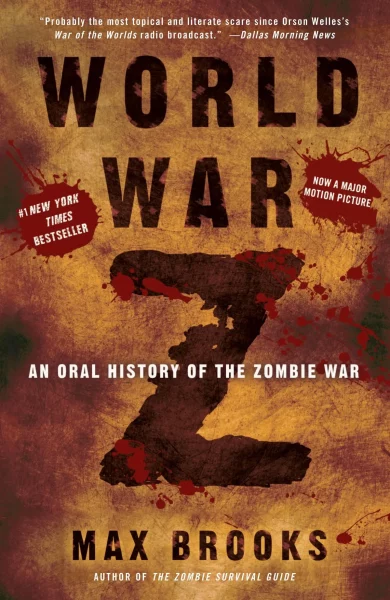
First off, it’s important to note that I listened to World War Z as an audiobook, not print. I tried the print format, and it just didn’t hit the same. On the page, the voices can blur together and the documentary tone/interview style can read a little dry. But the full-cast audiobook? That thing is a star-studded fever dream. Max Brooks (the author himself) acts as the interviewer, and with a cast of absolute heavy-hitters behind him, it stops feeling like “listening to a book” and starts feeling like you’ve stumbled into an oral history archive. I’ve listened to a lot of audiobooks. World War Z: The Complete Edition kicked the door in, took the crown, and demonstrated what happens when a book is finally allowed to become what it was always meant to be.
As an audiobook the format is now the secret sauce: hundreds of testimonies, each one a sharp little window into how people break, bend, adapt, and rebuild. Every interview delivers a different flavor of dread. Political dread. Logistical dread. Moral dread. The kind where you’re nodding along like, “Yes. That is exactly how institutions would behave,” and then immediately wishing you hadn’t been so right. Brooks has an unnervingly good grasp on people in crowds, people in power, people in denial, and people who keep going anyway.
What really floored me, though, is how much research and thought had to go into this. Rather than fixating on the undead, Brooks examines the living: how countries fracture or adapt, how propaganda spreads, and how survival shifts from fantasy to infrastructure. You can practically see Brooks at a desk surrounded by maps and history books, gleefully stress-testing every country’s cultural instincts and political reflexes, then following the consequences all the way down. The result is a world that feels terrifyingly plausible, not because zombies are believable, but because humans are.
Main character energy is intentionally low because “the interviewer” is basically a camera on a tripod, and that’s the point. The world is the protagonist. Geopolitics, survival logistics, and social order take the spotlight and generate the drama. This is not a “zombie action book” in the shallow sense. Zombies are the pressure cooker, the external force that strips away excuses. The real story is the sociology: fear, denial, scapegoats, misinformation, hard pivots, ugly choices, and then the long, grinding work of rebuilding something that resembles civilization again.
And honestly, zombies could be swapped out for almost anything. Replace them with a pandemic, a climate-triggered collapse, a resource war, or any world-changing catastrophe, and the skeleton of this story still stands. Zombies are convenient because they’re a clean metaphor: the faceless, relentless enemy that doesn’t negotiate, doesn’t tire, and doesn’t care about your politics. But the real monster here are not “the undead.” It’s what happens to humanity when survival becomes the only currency.
The secondary cast is enormous, uneven in the way real oral histories are uneven, and that’s why it works. Some voices are unforgettable, some are more functional, but together they form a mosaic of survival that feels disturbingly authentic. The only place I occasionally felt Brooks geeking out a little too hard was the military tech and tactical deep-dives, where you can tell he’s having a very good time and I’m not here to yuck his yum.
Also, friendly PSA: the movie is not a preview. It’s an alternate universe wearing the same name tag. The audiobook is the superior format, no contest. I finished it and immediately became That Person who can’t stop recommending it to strangers, friends, furniture, and anyone else in earshot (seriously, I got obnoxious about it). If you only do one version, do the audiobook. Then join me in being delightfully unbearable about it.